About the Project
A multi-institutional NSF DMREF effort to overcome the materials barrier for rotating detonation engines.
Designing Materials to Survive the Detonation Environment
Rotating Detonation Engines (RDEs) generate power by sustaining a circulating detonation wave in an annular chamber at thousands of meters per second, achieving power densities orders of magnitude higher than conventional engines while offering greater efficiency, more compact designs, and higher thrust-to-weight ratios. The technology is advancing rapidly — but the lack of materials capable of withstanding the extreme thermomechanical loads remains a critical barrier to deployment.
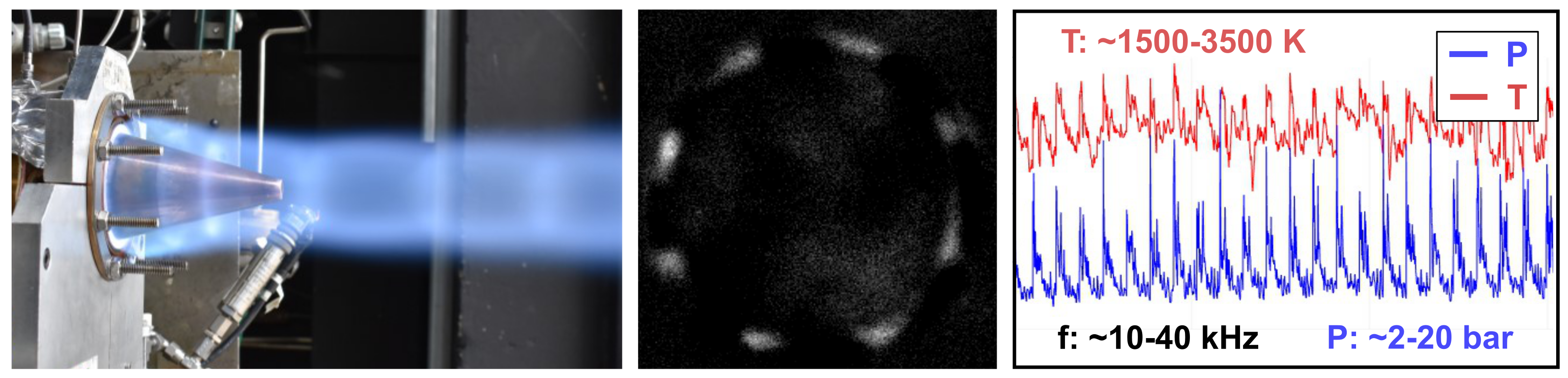
Thriving While Detonating establishes a synergistic, Materials Genome Initiative–informed platform for accelerated materials discovery. The team integrates a generative AI multi-agent framework, a first-of-its-kind miniaturized RDE materials testing platform, and cold-spray and directed-energy-deposition additive manufacturing to enable closed-loop design of copper-based alloys under realistic RDE conditions. Outcomes will inform broader classes of structural alloys for propulsion and power generation.
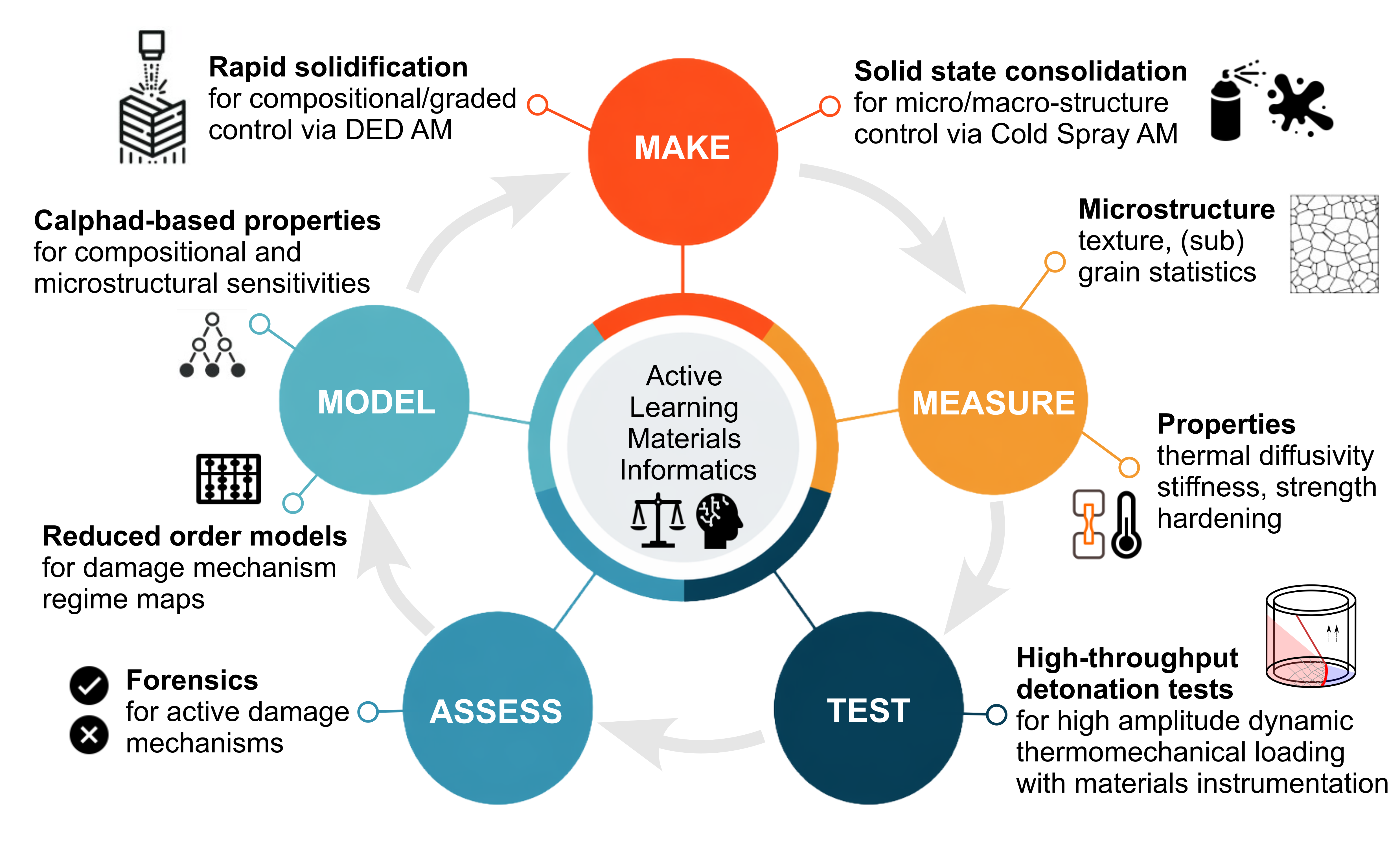
Research Thrusts
Four interlocking thrusts that span physics, characterization, manufacturing, and informatics.
🚀 RDE Physics & Testing
Building a miniaturized RDE materials testing platform to rapidly screen candidate alloys under realistic detonation conditions, and establishing standardized testing protocols.
🔬 Characterization & Forensics
Linking processing defects to failure modes through high-resolution microscopy, post-mortem damage analysis, and damage / failure regime maps.
🏗️ Advanced Additive Manufacturing
Leveraging directed energy deposition (DED) and cold-spray to process copper-based alloys with site-specific microstructural design.
🧠 Modeling & Materials Informatics
Coordinating experiments and simulations via a generative AI multi-agent framework, CALPHAD-based thermodynamics, and uncertainty-responsive reduced-order models.
Project Timeline
Major milestones and events. Click any entry for details. Upcoming markers highlight planned activities.
Feb 2025
Proposal Submitted to NSF DMREF
Full proposal submitted to the NSF Designing Materials to Revolutionize and Engineer our Future (DMREF) program — a multidisciplinary collaboration led by Lehigh University with UC Irvine and Carnegie Mellon University.
Aug 2025
NSF Award FundedMilestone
NSF DMREF Award #2522673 funded at $2M over four years, supporting the project through 2029.
Read the partner institution announcements:
Oct 2025
Project Kick-Off Meeting
Inaugural project-wide kick-off bringing together PIs, co-PIs, AFRL partners, and industry stakeholders to align research thrusts, testing infrastructure, and the first round of candidate materials.
Dec 2025
Mini-RDE Platform Built & First FireMilestone
The miniaturized RDE materials testing platform was assembled at UCI and achieved successful first fire, establishing the project's high-throughput screening capability for candidate alloys under representative detonation conditions.
Mar 2026
Workshop: Thriving While Detonating @ UC Irvine
A one-day workshop at UCI's CALIT2 Auditorium bringing together academic, government, and industry experts in RDE physics, characterization, additive manufacturing, and materials informatics. Four panel sessions, lab tours, and a wine-and-cheese reception.
May 2026
IWDP 2026 Presentation — International Workshop on Detonation for Propulsion
Project results and early materials testing approaches presented at the International Workshop on Detonation for Propulsion (IWDP 2026).
Mar 2027
Second Project Workshop & Industry DayUpcoming
Follow-on workshop to share project outcomes with the broader RDE community and to engage industry stakeholders on translation pathways.
This timeline is updated as the project progresses. Last updated: August 2026.
People
Faculty, students, and postdocs from Lehigh, UC Irvine, and Carnegie Mellon, working with partners at AFRL and industry.
Principal Investigators & Partners







Students & Postdocs






Products
Publications, presentations, and other research outputs produced under the project.
Conference Proceedings N. J. Dudko, D. Menendez, M. Ross, S. E. Yang, S. M. Taheri-Mousavi, L. Valdevit, D. Mumm, M. Begley, X. Shi, N. Vermaak, “Experimental investigation into the thermomechanical vibratory response of uncooled rotating detonation engine combustor liners,” 2027 AIAA SciTech Forum, Orlando, FL, USA, January 11–15, 2027.
AcceptedConference Proceedings M. Ross, D. Menendez, X. Shi, D. Mumm, L. Valdevit, N. J. Dudko, N. Vermaak, S. E. Yang, S. M. Taheri-Mousavi, “Microstructural influence on material degradation in a rotating detonation engine,” 2027 AIAA SciTech Forum, Orlando, FL, USA, January 11–15, 2027.
AcceptedConference Proceedings D. Menendez, M. Ross, L. Valdevit, D. Mumm, X. Shi, N. J. Dudko, N. Vermaak, “Mapping material responses and failure mechanisms for a heat-sink rotating detonation engine,” 2027 AIAA SciTech Forum, Orlando, FL, USA, January 11–15, 2027.
AcceptedJournal N. J. Dudko, M. R. Begley, X. Shi, N. Vermaak, “Scaling relationships governing the thermomechanical response of rotating detonation engine combustor liners,” Materials & Design, vol. 269, 116729, 2026.
doi.org/10.1016/j.matdes.2026.116729 →Conference Abstract D. K. Menendez, M. W. Ross, D. R. Mumm, L. Valdevit, X. Shi, “Component and material failure mechanisms in miniaturized rotating detonation engines,” 14th International Workshop on Detonation for Propulsion (IWDP 2026), Keio University, Yokohama, Japan, May 4–8, 2026.
View extended abstract (PDF) →Workshop Archive
Materials and program from past events organized under the project.
Thriving While Detonating — 2026 RDE Materials Workshop
UC Irvine · CALIT2 Auditorium · March 13, 2026
One-day workshop with four panel sessions spanning RDE physics, materials characterization, advanced additive manufacturing, and materials informatics. Featured panelists from AFRL, Boeing, ATI, Los Alamos National Lab, and leading universities.
Sponsors
This material is based upon work supported by the National Science Foundation under Award No. 2522673. Any opinions, findings, and conclusions or recommendations expressed in this material are those of the author(s) and do not necessarily reflect the views of the NSF.
The 2026 Workshop was generously supported by the UCI Samueli School of Engineering, whose contribution made the gathering of our academic, government, and industry partners possible.
Collaborators


- Air Force Research Laboratory
- The Boeing Company
- ATI Specialty Alloys and Components
Contact
For collaboration inquiries, please contact the PI and co-PIs at Lehigh, UCI, and CMU.